📍 Distributing from 7 Locations!
🏆 #1 Distributor in North America

Rock Crete Permeable Base for Resin Bound Driveways

Rock Crete · Permeable Base System

Rock Crete Permeable Base for Resin Bound Driveways

Resin bound surfaces rarely fail. The base underneath them does. Rock Crete is a fully permeable, monolithic base that bonds to the surface above it — laid straight over sound concrete or asphalt, with no excavation, no dumpster on the driveway, and the whole job finished in a day.

100%Permeable, SuDS compliant
ZeroExcavation over a sound surface
One dayBase and surface, same visit
MonolithicBonded to the wearing course
Two-time award-winning supplier SuDS compliant drainage Installed in a single day Shipping from 7 US locations

The problem

Why resin bound driveways crack —
and it is almost never the resin

Ask any installer who has been called back to a failed driveway and the story is nearly always the same. The surface did what it was supposed to. The ground under it moved.

Loose crushed stone settles

A compacted aggregate base is thousands of separate stones held together by nothing but friction. Under a car, over a wet winter, they migrate. The surface above has nothing to span the void, so it dishes — and then it splits.

Concrete is rigid, and rigid things telegraph

Poured concrete does not flex. When it cracks — and slabs crack — the crack travels straight up through anything bonded to it. A perfect resin bound job over a cracking slab will show that crack within two seasons.

Asphalt is sealed, so the water has nowhere to go

Water passes through the resin bound surface exactly as designed, hits a sealed asphalt layer, and stops. In a freeze–thaw climate it expands, breaks the bond, and the surface begins to lift at the edges.

Rock Crete removes all three failure modes at once. It is bound, so nothing migrates. It is flexible, so it absorbs movement instead of transmitting it. It is fully permeable, so water keeps travelling down and out.

What Rock Crete is

A base that moves with the surface instead of against it

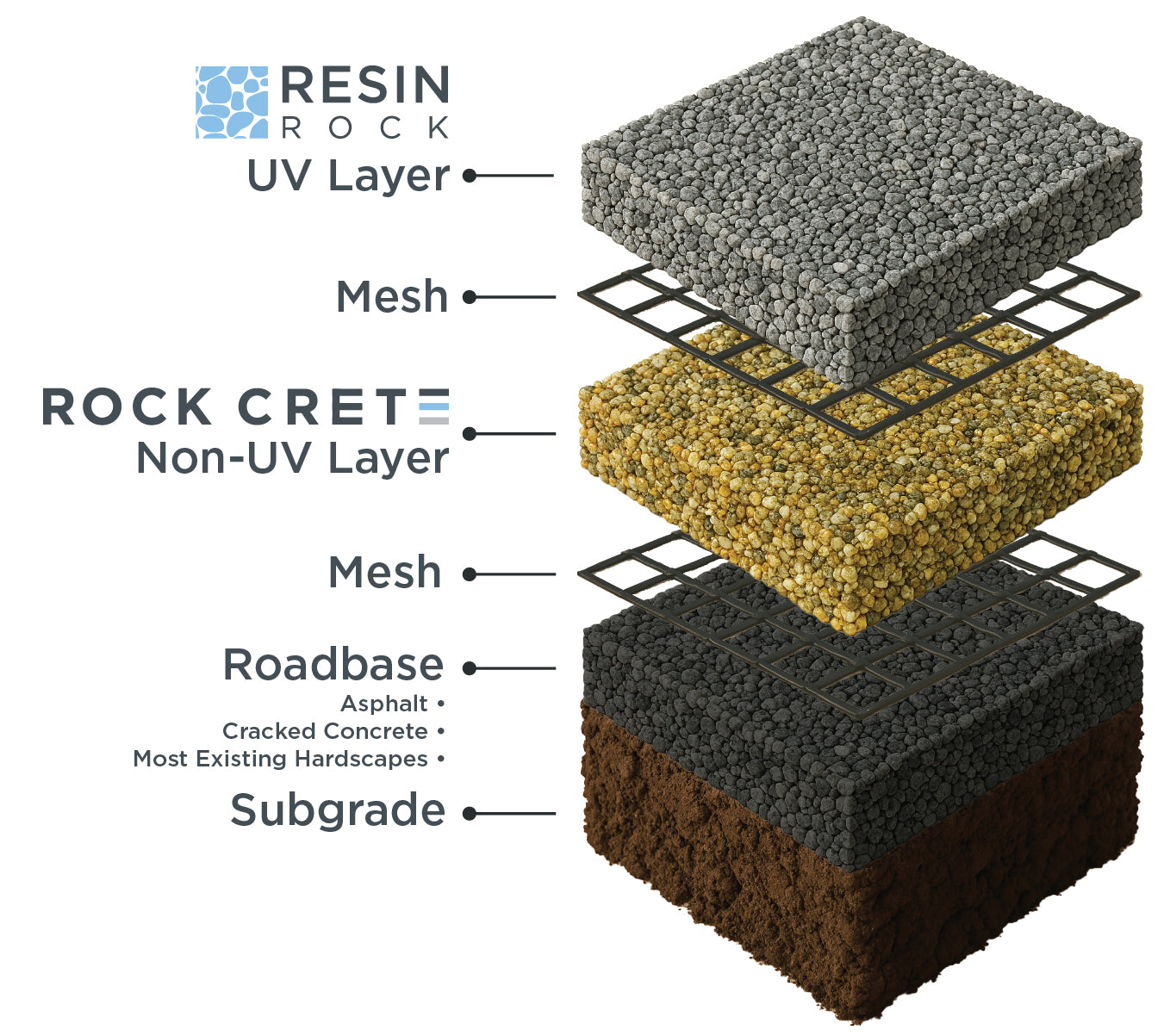
Rock Crete is graded aggregate bound in a polyurethane resin and laid in two courses — Rock Crete Base for structure and Rock Crete Top as the bonding layer — over a structural reinforcement mesh.

Laid within the intercoat window, the base and the resin bound surface above it cure into one bonded structure rather than two layers sitting on each other. That is the word doing all the work here: monolithic. Loads spread across the whole slab instead of concentrating where the wheel sits, and the surface and base flex together, so movement in the ground below never becomes a crack you can see.

Because the aggregate is bound rather than compacted, the voids between the stones stay open permanently. Water drains through the wearing course, through the base, and into the ground beneath — the full SuDS path, with no separate drainage run, no channel drain and no soakaway.

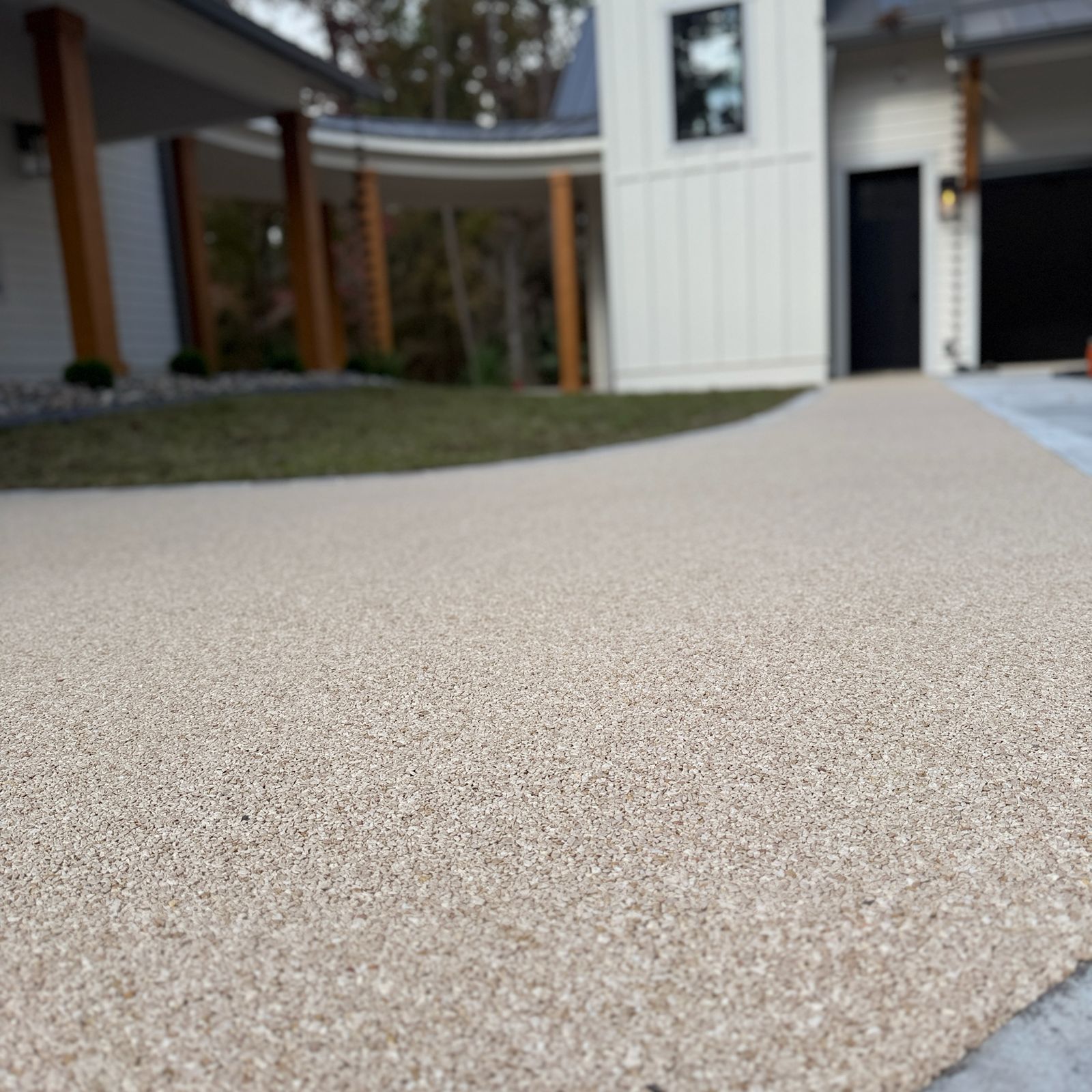
Rock Crete permeable resin bound base being laid over an existing surface

Rock Crete laid over an existing surface

The system

Six layers, one bonded structure

Scroll to build the system up layer by layer, then drag to rotate it. Read from the ground up.

Loading the interactive build-up…

Diagram of the Rock Crete build-up: existing surface, structural mesh, Rock Crete Base, Rock Crete Top, resin bound wearing course and anti-slip glass

The full Rock Crete build-up, ground up

The part nobody else offers

Laid over what you already have

Most driveways being resurfaced in America do not need excavating. They need covering.

If the existing concrete or asphalt is sound — no heave, no significant settlement, no active subsidence — Rock Crete goes straight over the top of it.

That removes the demolition, the dumpster, the disposal fee, the sub-base regrade and the week of a torn-up driveway. It is the difference between a job that takes a day and a job that takes a fortnight, and it is usually the difference between a homeowner saying yes and saying “let me think about it”.

The honest caveat: if the existing surface is heaving, sinking or breaking up, that has to be dealt with first — covering a moving slab only hides the problem for a season. Send us a photo and we will tell you which one you have.

Image slot
Before / after slider —
cracked concrete drive, then the
same drive finished in resin bound

Compared

Rock Crete against the alternatives

The four things a resin bound surface actually gets built on, side by side.

Base options for resin bound surfacing
  Rock Crete Poured concrete Asphalt Compacted crushed stone
Fully permeable Yes No No, unless open-graded Yes, until it silts up
Bond to the resin surface Monolithic Mechanical only Mechanical only No bond
Under ground movement Flexes with it Cracks, telegraphs up Deforms and ruts Settles
Excavation required None over a sound surface Full dig-out Full dig-out Full dig-out
Install time, typical drive One day 2–3 days plus cure 1–2 days plus cooling 1–2 days
Wait before the surface goes on Same day, within the intercoat window 21–28 days Up to 30 days off-gassing Immediate
Flexural strength FLEXURAL FIGURE + ASTM STANDARD High but brittle Baseline Not applicable
Load rating LOAD FIGURE High, rigid Moderate Depends on compaction
Freeze–thaw Water drains — nothing to expand Trapped water spalls the slab Trapped water lifts the bond Frost heave
Stormwater / SuDS compliant Yes No No Initially
Recycled content Yes No Some Varies
Material cost per sq ft $ FIGURE $ FIGURE $ FIGURE Cheapest

Crushed stone is cheaper per square foot and always will be. It is the right answer under a shed and the wrong answer under a bonded surface you want to look the same in ten years.

Specification

The numbers, in full

Everything a specifier, a building inspector or a careful contractor will ask for. The same figures appear on the downloadable datasheet.

System type
Two-course bound permeable base — polyurethane binder with graded aggregate, over structural reinforcement mesh
Laid thickness — foot traffic
1.5 in (38 mm)
Laid thickness — vehicular
2 in (50 mm)
Laid thickness — heavy vehicle
CONFIRM
Load rating
SINGLE AGREED FIGURE — site currently states 30,000 lb, 40,000 lb and 44 tonnes in three places
Flexural strength vs asphalt
FIGURE + ASTM C78 or C293
Infiltration rate
FIGURE + ASTM C1701
Binder
Non-UV polyurethane resin, two-part
Aggregate
Graded recycled aggregate — SIZE RANGE
Reinforcement
Structural mesh, full-area lay
Coverage per kit
SQ FT PER KIT BY THICKNESS
Pot life
MINUTES, TEMPERATURE DEPENDENT
Foot traffic
HOURS
Vehicle traffic
HOURS
Intercoat window
HOURS — the window that makes the bond monolithic
Application temperature
RANGE °F
Slip resistance, finished surface
Up to 45 PTV with anti-slip glass broadcast into the wearing course

Build-ups

Pick the build-up that matches your job

One page each: layer stack, thickness, mesh spec, coverage, load rating and the full materials list.

Class 1

Foot traffic & paths

Garden paths, side returns, walkways and anything that will never see a wheel.

Download PDF →
Class 2

Patios & pool decks

Foot traffic with standing water and bare feet. Anti-slip glass specified as standard.

Download PDF →
Class 3

Residential driveways

Cars, light trucks and daily turning loads on a domestic drive.

Download PDF →
Class 4

Heavy vehicle & commercial

Delivery access, forecourts, parking and municipal work.

Download PDF →

The no-crack guarantee

If a crack appears in a Rock Crete base within five years of a certified installation, we repair it. In writing, on the datasheet, no argument. TERMS TO BE SET — certified installers, registered installations, sound-substrate conditions

Questions

Rock Crete, answered

Can I lay resin bound over my existing concrete?

Yes, if the concrete is sound. That means no active heave, no significant settlement and no sections breaking up. Hairline cracking and surface wear are fine — that is exactly what Rock Crete is designed to cover and bridge. Send us a photo and we will tell you honestly which category yours falls into.

How do I know whether my base is sound enough?

Three checks. Stand on any cracked section and see whether it rocks or moves — movement means it needs addressing first. Look for level differences of more than about a quarter inch across a crack, which suggests settlement rather than shrinkage. And check whether water pools in the same spot after every storm, which usually means the slab has dropped. Any of the three and an installer should look at it before quoting.

Is Rock Crete permeable?

Fully. Water passes through the bound stone structure and into the ground below, which is what makes the finished system SuDS compliant without a separate drainage run, channel drain or soakaway.

How strong is it compared with asphalt?

ANSWER PENDING THE AGREED FIGURE AND TEST STANDARD. Rock Crete is designed to flex rather than fracture, spreading load across the whole bonded slab instead of concentrating it under the wheel.

Do I need to excavate?

Not over a sound existing surface. Rock Crete is laid directly onto sound concrete or asphalt, which removes the demolition, the disposal and most of the timeline. Over bare ground you will need a properly compacted sub-base beneath it.

How thick should Rock Crete be laid?

1.5 inches for foot traffic and 2 inches for vehicular areas, with heavy vehicle and commercial build-ups specified separately. The four downloadable build-up guides give the full layer stack for each traffic class.

How long does an installation take?

A typical residential driveway is a single day for base and surface together, because the resin bound wearing course is laid within the intercoat window rather than waiting for a separate cure.

Will it survive freeze–thaw and snowplows?

Yes on both counts. Because the system drains rather than holding water, there is nothing trapped in it to freeze and expand — which is the mechanism that destroys sealed bases in cold climates. The finished surface takes snowplowing and routine winter maintenance.

Does it bond to the resin bound surface?

Yes. Laid within the recommended intercoat period, Rock Crete Top and the resin bound wearing course cure into a single monolithic structure, so every layer moves as one.

What does Rock Crete cost per square foot?

RANGE TO BE ADDED. Cost is driven by laid thickness, the condition of the existing surface, site access and the aggregate blend chosen for the wearing course. Use the coverage calculator for a material figure on your own square footage.

Can I install it myself?

Small paths and patios are within reach of a confident DIYer working from the build-up guide. Driveways are not a first project — pot life is short, the intercoat window is unforgiving, and a base laid badly is expensive to put right. For anything vehicular, use a certified installer.

Next step

Two ways to start

Homeowners

Can Rock Crete go straight over mine?

Send a photo of your driveway or patio. We will tell you whether it can be laid over what you already have, and match you with a certified installer near you.

Contractors & specifiers

Price a Rock Crete base for your next job

Run the coverage calculator, download the build-up for your traffic class, and order base, top and stone in one place.

Before this goes live Every HIGHLIGHTED value is a placeholder. Search the file for the word "tbd" to find all of them. The load figure, the flexural figure and the infiltration figure each need one agreed number and the standard it was measured to before this page is published. Image slots are marked with dashed boxes.