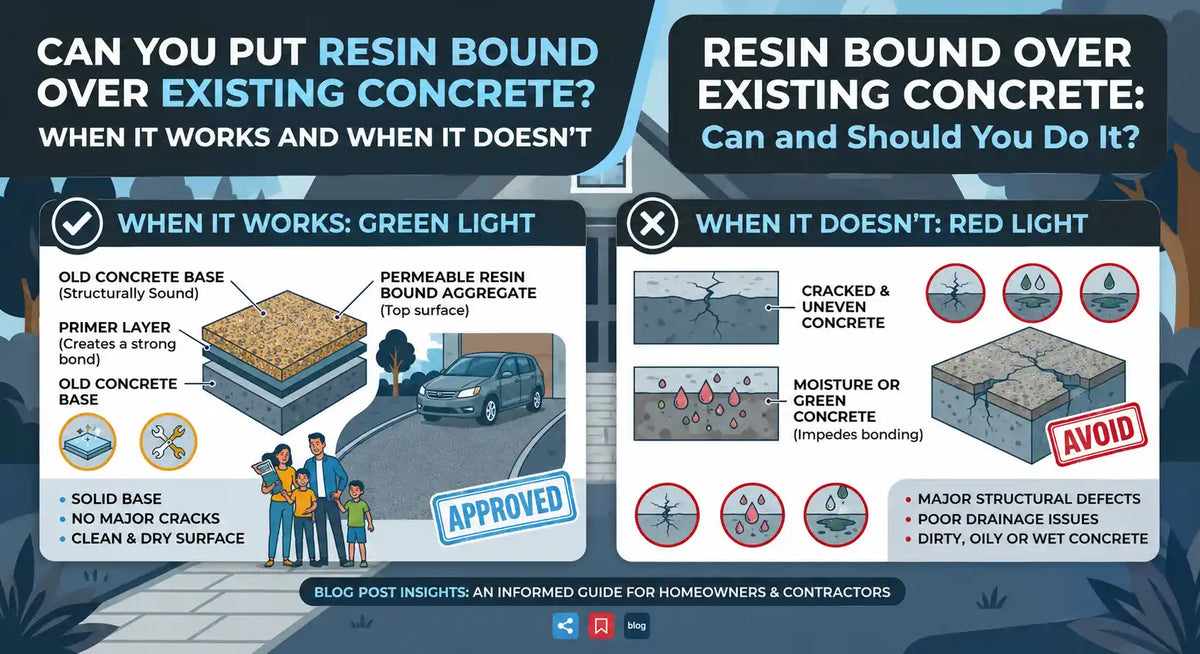
Yes. Resin bound surfacing can be installed directly over existing concrete when the slab is structurally sound, clean, dry and stable. Hair cracks can be filled and concealed. Heaving, deteriorating, or moving slabs have to be fixed or replaced. Since solid concrete is nonporous, there should be a slope on the concrete to allow water drainage.
That cracked, gray driveway or pool deck does not have to be torn out. In many cases, it can become the base for a smooth, decorative resin bound finish that covers stains, surface cracks and tired concrete in a day or two. The catch is that resin bound is only as good as what sits underneath it.
At Resin Rock, we supply materials and train people all across North America, and most of the failures that come to us boil down to concrete that never had proper checks. With this guide, you are going to get a look at a few things that can help confirm a slab is ready, what problems need to be taken care of first, and when resin bound over concrete is not the right choice.
Key takeaways
-
Resin bound can go over concrete that is at least 4 inches thick, fully cured and free of movement.
-
Hairline and static cracks can be filled and covered; active or wide cracks need a structural fix first.
-
Over concrete, plan for about 1/2 inch of resin bound for foot traffic and 3/4 inch for driveways.
-
Water drains through the resin bound layer but not through the concrete, so the slab needs a fall (slope).
-
Grinding or shot blasting, priming and edge trims are what make the bond last.
Why Resurface Concrete With Resin Bound Instead of Replacing It?
Resurfacing avoids the most costly and time-consuming portion of driveway replacement: breaking up and removing the old slab, and hauling it away for disposal. Jobs are often completed in a matter of days, rather than weeks, saving you both time and money.
And you also get a finish that plain concrete can't beat. Resin bound is a mixture of clear binder and natural stone, hand trowelled to a seamless surface. Hides stains and cracks and provides a textured finish even when wet. There are over 30 types of stone to pick from. If you want to see the change before committing, try the Live Visualizer, which shows a concrete pool deck turning into a resin bound surface. For a deeper look at the two materials side by side, read our resin bound vs concrete driveway comparison.
Is Your Concrete Ready? The 7-Point Condition Check
Run through these seven checks before ordering any materials. If the slab fails one, fix that issue first or choose a different base.
|
Check |
Pass |
Fail (fix first) |
|
1. Thickness |
At least 4 inches |
Thin or patchy slab: replace or build a new base |
|
2. Age |
Fully cured, at least 28 days old |
New concrete: wait until cured |
|
3. Movement |
No rocking, heaving or sunken sections |
Moving slabs: lift, stabilize or replace |
|
4. Cracks |
Hairline or static cracks only |
Wide or active cracks: structural repair |
|
5. Surface strength |
Hard, no crumbling or scaling |
Flaking or dusty surface: grind back to sound concrete |
|
6. Contamination |
No oil, paint, sealer or curing compound |
Degrease and grind until bare |
|
7. Moisture and drainage |
Dry slab with a fall of about 1:60 to 1:80 |
Damp slab or flat spots that hold water: correct before laying |
A quick and simple way to check moisture content is to tape a 2x2 sheet of plastic on the slab for 24 hours to see if the bottom of the plastic is damp or the slab has darkened. The latter means that the slab is too moist for proper bonding with resin, which can lead to a hazy or weak finish.
Which Cracks Can You Cover, and Which Need Repair First?
Resin bound will hide cracks visually but will not prevent a crack that is growing. If the concrete is still displacing itself, cracks will appear through the resin bound surface within a season or two.
|
Crack type |
What it looks like |
What to do |
|
Hairline (under 1/16 inch) |
Fine, shallow, not growing |
Clean out, fill with a suitable repair resin, then cover |
|
Static (1/16 to 1/4 inch) |
Wider but stable, edges level |
Route out, fill and prime before laying |
|
Active or widening |
Gets bigger over time, opens seasonally |
Find the cause and stabilize the slab first |
|
Displaced (one side higher) |
A step or lip across the crack |
Grind level or lift the slab; may need replacement |
|
Expansion and control joints |
Planned straight lines in the slab |
Carry the joint through the resin bound layer with an expansion joint trim |
That last row is more important than you think. Covering a working expansion joint is the most common cause of resin bound cracks in straight lines months later.
How Thick Should Resin Bound Be Over Concrete?
Because the concrete already carries the load, resin bound overconcrete can be thinner than a full new build. Match thickness to traffic and stone size.
|
Use |
Typical thickness |
Common aggregate size |
|
Paths, patios, pool decks |
1/2 inch (about 12 mm) |
1–3 mm or 2–5 mm |
|
Residential driveways |
3/4 inch (about 18 mm) |
2–5 mm or 3–6 mm |
|
Heavier or commercial traffic |
1 inch (about 24 mm) |
3–6 mm |
Use a UV-stable binder anywhere the surface sees direct sun, or light stone can yellow over time. Our guide to what a UV resin binder does explains why. For help choosing stone, see 7 things you need to know about resin bound aggregates. To work out how much material you need, use the Resin Rock calculators.
Does Resin Bound Over Concrete Still Drain?
Partly. The resin bound layer is permeable to water; this will pass through to a point where it will meet solid concrete and be blocked. From here, it has to find an exit along the slab to either an edge, drain or lawn. This is why the fall-in check 7 is not optional. If this is not carried out, the water has nowhere to go and can stain, freeze or compromise the bond.
If full permeability matters, for example, to meet local stormwater rules, ask about the Rock Crete permeable base. Rock Crete Top can be laid directly atop existing concrete or asphalt without excavation, at 1.5" for pedestrian traffic and 2" for vehicles, to create a strong, free-draining base for resin bound.
How Resin Bound Is Installed Over Concrete: Step by Step
-
Inspect and repair: Run the 7-point check, fix cracks and level any lips.
-
Prepare the surface: Diamond grind or shot blast to remove laitance, sealers and contamination, then vacuum clean.
-
Set the edges: Fix edge trims around open edges so the resin bound layer has a clean, protected finish line.
-
Prime: Apply the primer recommended for your binder so the resin bonds to the concrete, not to dust.
-
Mix: Combine binder and dry aggregate in a forced action mixer such as a Baron mixer for an even coat on every stone.
-
Lay and trowel: Spread to the target depth and hand trowel to a flat, consistent finish without overworking it.
-
Cure: Keep foot traffic off for 6 to 8 hours and vehicles off for 24 to 48 hours, longer in cool weather.
Our full step-by-step resin bound installation guide goes deeper into the mixing and troweling technique.
When You Should Not Lay Resin Bound Over Concrete
Some slabs are not worth saving. Skip the overlay and plan a new base if any of the following apply:
-
The slab is broken into loose pieces or has large sunken areas.
-
Tree roots or poor soil are still lifting the concrete.
-
The surface holds standing water and cannot be given a fall.
-
Moisture keeps rising through the slab after a dry spell.
-
The concrete is thinner than 4 inches under a driveway.
In these cases, resin bound will fail for reasons that have nothing to do with the resin. An approved installer can tell you on-site whether to resurface, repair or rebuild.
Frequently Asked Questions
Can you put resin bound over a cracked concrete driveway?
Yes, if the cracks are hairline or static. Clean & fill, prime the slab, and lay the resin bound. Cracks that are still active or are uneven need to be stabilized first; otherwise, they will appear through the new surface.
Do you need to prime concrete before laying resin bound?
Yes. A primer seals the dusty surface of the concrete and provides something for the binder to grab onto. Skipping it is a common cause of delamination, where the resin bound layer lifts away from the slab.
How long does resin bound over concrete last?
With a sound slab, proper preparation and a UV stable binder 15 years or more is realistic. It is mostly down to the condition of the concrete below and the installation.
Is resin bound over concrete permeable?
The resin bound layer is permeable; concrete is not. Water will drain down through the stone and run off across the slab, so the surface of the slab needs to have a fall. If you want a fully permeable surface, you should use a permeable base such as Rock Crete.
Can you lay resin bound over a concrete pool deck?
Yes, and it is one of the most popular uses. It gives a textured, slip resistant finish around the pool. Choose lighter stone in full sun and read our guide to resin bound for pool decks for heat and chlorine advice.
Can I install resin bound over concrete myself?
Small paths and patios are possible with a resin bound kit if you are handy. Driveways are harder because surface prep, priming and working time leave little room for error. Our DIY vs approved installer guide breaks down the risks.
Can resin bound be laid over concrete in cold weather?
It can, although cure times will be much longer, and moisture can become an issue. Most binders require dry conditions and temperatures above 41 deg F (5 deg C). Check technical data sheets for specific binders and avoid laying on frosted or damp slabs. Our post on resin driveways in winter weather covers how the finished surface performs.
Turn Your Old Concrete Into a Resin Bound Surface
If your slab passes the 7-point check, it is already halfway to a new driveway, patio or pool deck. Resin Rock supplies resin binders, aggregates, trims and tools from distribution points across the U.S. Homeowners can find an approved installer nearby. Contractors who want to add concrete resurfacing to their services can train with Resin Rock. For a quote or samples, contact our team.
Looking for traditional overlay options as well? See our concrete overlay solutions.